Stable reboiler performance
Reboilers supply the required heat for operating distillation columns and are therefore a key component of many processes in the food, chemical, textile, paper, sugar, oil, and refinery industries. The liquid from the column bottom is heated in the reboiler and then fed back to the column in order to keep the distillation process going. A commonly used variant are forced-circulation reboilers, in which the process medium is conveyed at a high flow velocity through the heat exchanger. They are used, in particular, when highly viscous media are processed or when the process is prone to severe fouling. Stable heat transfer is crucial for plant availability, product quality, and profitability in these applications, in particular.
Fouling and scaling as a process bottleneck
Fouling and scaling are among the biggest challenges in reboiler operation. Dirt particles, polymers, corrosion products, or mineral deposits can settle on the heat transfer surfaces and form insulating layers. The result is that the total heat transfer coefficient drops, the reboiler performance decreases, and the stability of the distillation process is impaired. In order to maintain the required heating capacity, conventional reboilers often have to be cleaned or replaced. This interrupts production, increases the maintenance workload, and leads to financial as well as energy losses. What starts out as slow scaling can ultimately restrict the flow rate, reduce process efficiency, and increase operating costs significantly.
The solution: Klaren Heat Exchanger
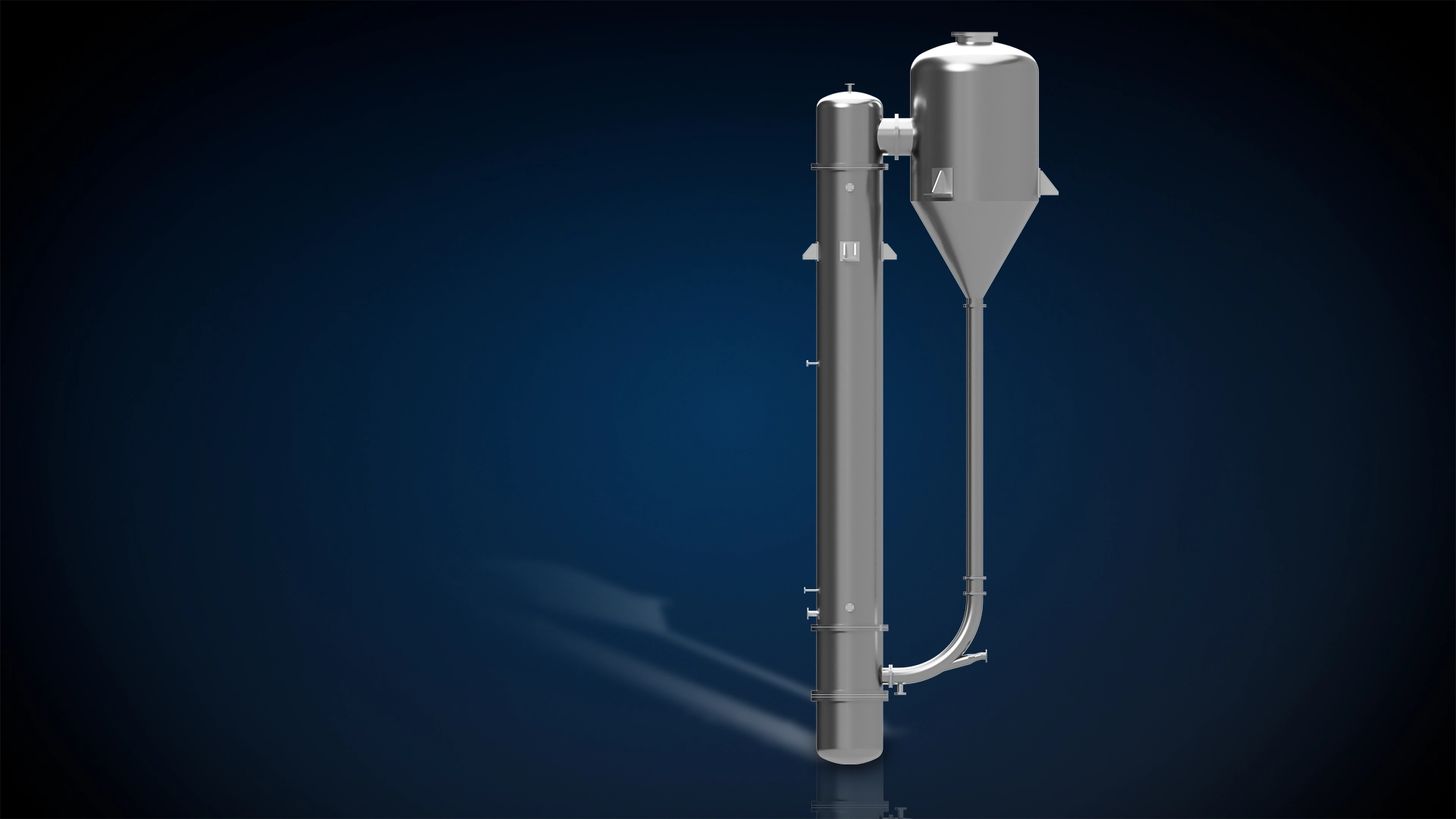
The Klaren heat exchanger is particularly well suited for vertical forced-circulation reboilers and keeps the inner surfaces of the tubes clean during ongoing operation. The system is based on a vertical shell-and-tube design and has a self-cleaning mechanism that continuously prevents fouling and scaling before deposits can impair the heat transfer process. On the tube side, the process medium flows together with special cleaning particles upwards from below through the tubes, where the cleaning particles form a fluidized bed. They are kept in controlled motion by the flow and generate a continuous, gentle scouring action along the tube inner walls. Deposits are removed as soon as they start to appear; before they can form a performance-limiting fouling layer. A specially designed and engineered inlet distribution system ensures a uniform flow and a homogeneous distribution of the cleaning particles across all tubes. This keeps the cleaning effect stable across the entire heat transfer area – even in challenging process conditions and with fluctuating operating loads.
Stable heat transfer, stable distillation
TAPROGGE Solutions
Thanks to the continuous prevention of scaling, the heat transfer surfaces remain clean and fully available for the heat transfer. The total heat transfer coefficient remains stable, the reboiler performance is maintained, and the required heat input to the distillation column can be reliably supplied over long operating times. Stable heat transfer helps to maintain constant circulation rates as well as steady-state column operation.
Consistent performance. Less fouling.
Consistent performance and reduced fouling help to maintain product quality and process efficiency at a constant level, even over extended operating periods. At the same time, the self-cleaning function significantly reduces the need for mechanical or chemical cleaning, as well as other fouling control measures. Existing vertical forced-circulation evaporators with heavy fouling can often be retrofitted to a self-cleaning configuration with relatively little effort. This allows plant performance to be improved without having to replace the entire unit.
Long track record in continuous operation
The advantages of the self-cleaning heat exchanger really shine through in industrial long-term operation. In one particular chemical application, a steam-heated reboiler was used to recover a volatile organic component from a heavily fouling organic solution. Beforehand, hard black deposits formed in the upper section of the tubes, requiring the plant to be switched over to a cleaned standby unit every four to five days. However, after a self-cleaning heat exchanger was installed, operation became more stable in the long run. The plant has been running for over 20 years without regular cleaning – compared to about 70 cleaning operations per year with the conventional reboiler. At the same time, the circulation rate remained constant, resulting in stable column operation, a higher overall throughput, and improved recovery of the organic component. The residue in the column bottom could also be concentrated to a greater degree.
CONTACT
Speak to
our experts!
Every application is different. Together, we clarify your requirements and find a solution that is technically and economically suited to your application.

More performance, less downtime
Thanks to the continuous self-cleaning, the reboiler performance remains stable in the long term even in applications that are highly susceptible to fouling. Owners benefit from higher plant availability, fewer shutdowns for cleaning, less maintenance work, and a more stable distillation process. At the same time, capacity and product recovery can be improved and operating costs can be reduced.